
The Kohen’s Garments
For honor, beauty and sacred service. The priestly garments express purity, humility, service, cleanliness, discipline and beauty—not merely as external decoration, but as part of the Kohen’s service itself.
“For honor and for beauty”
The Torah does not describe the priestly garments as incidental work clothes, nor as theatrical costume. It gives them a concise definition: honor and beauty.
“You shall make sacred garments… for honor and for beauty.”
Exodus 28:2
Their beauty does not depend upon excessive decoration. It comes from exceptional material, precise weaving, spotless cleanliness, proper proportion, disciplined form, and color only where the Torah assigns color.
The result is a distinctive visual language: splendor without ostentation, humility without poverty, and beauty entirely directed toward service.
The service uniform of Israel’s priesthood
The priestly garments are not scenery. They are a defined system of clothing worn by a man entering a sacred working environment in which every movement is directed toward service.
The Kohen stands, walks, lifts, carries, receives, gives and works. His garments therefore have to remain orderly, stable, modest and suitable for real physical activity.
Four garments. One function.
The ordinary serving Kohen wears four garments: the ketonet, michnasayim, avnet and migba’at. Together they form one disciplined system of priestly dress.
Ketonet
The principal white linen tunic, establishing most of the visible silhouette of the Kohen.
Michnasayim
The inner linen trousers of modesty and secure movement, largely concealed beneath the ketonet.
Avnet
The exceptionally long sash, wrapped repeatedly around the torso and bringing structure and color to the garments.
Migba’at
A long linen strip wrapped into a clean, raised and stable cap-like head covering.
The Ketonet
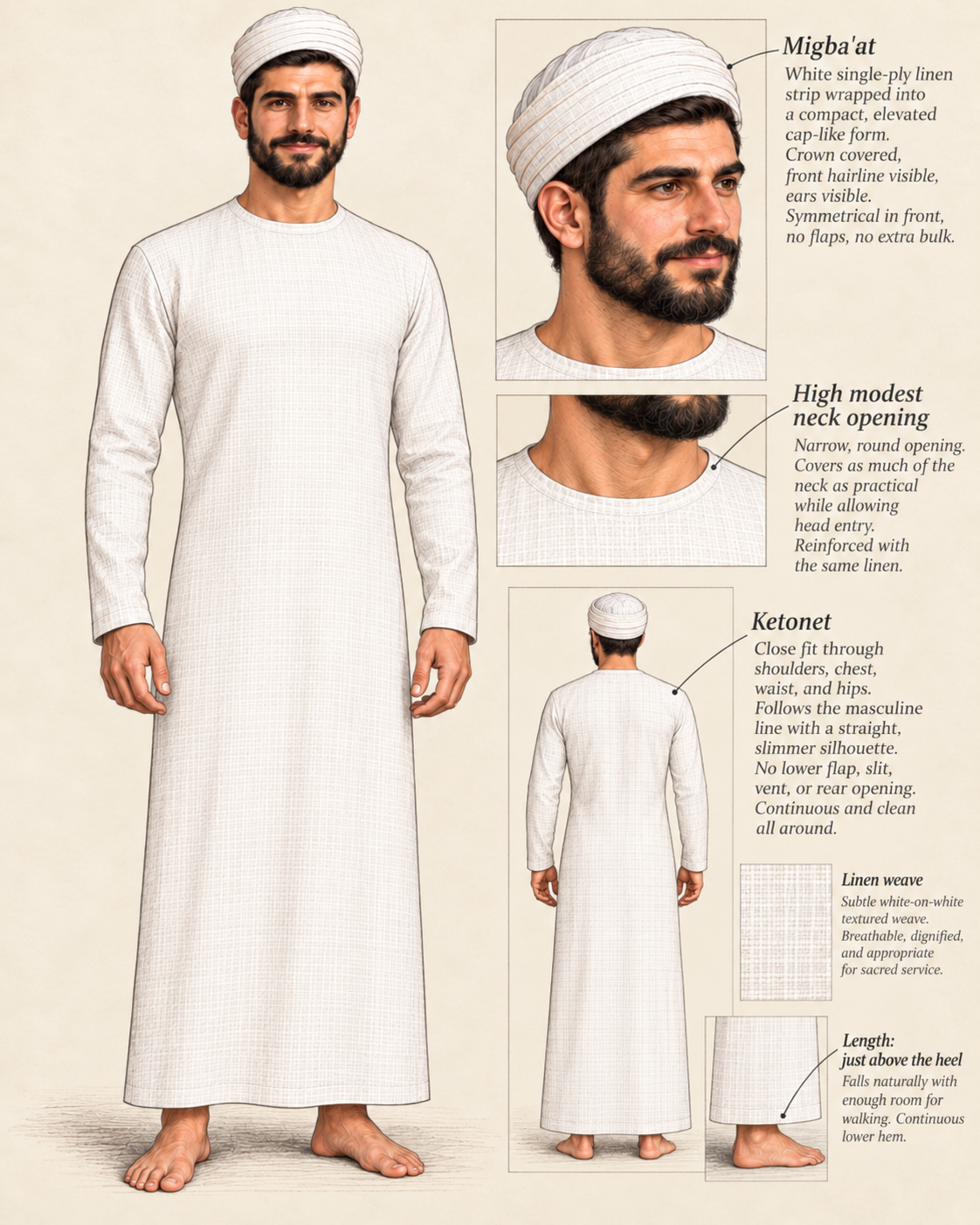
The ketonet is the principal outer garment of the ordinary Kohen: a long white linen tunic whose weave, proportion and cleanliness establish most of the visible character of the priestly garments.
Maimonides describes the ketonet as meshubetzet—woven with small cells or compartments formed within the weave itself. The effect should therefore be subtle white-on-white texture, not applied decoration or a bold modern checkerboard.
The garment is made to the Kohen’s measure. It should follow the shoulders, chest, waist and masculine hip line closely, with only the functional ease demanded by non-stretch woven linen and unrestricted movement during service.
Below the hips the garment falls naturally and opens only as much as required for walking, bending and working. The lower body remains continuous: no slit, flap, vent or decorative opening.
The neck opening in this reconstruction is intentionally high and modest: only large enough to permit the head to pass comfortably. It is finished with the same white linen to protect the edge from wear. The exact geometry and finishing method are a practical reconstruction; the classical sources do not specify a modern collar or separate throat flap.
- Material Fine white linen.
- Weave Subtle woven-in meshubetz texture; white-on-white rather than applied ornament.
- Neck High, narrow and modest; no standing collar, buttons or decorative flap.
- Fit Individually proportioned with minimal functional ease; close through shoulders, torso and hips without restricting movement.
- Sleeves Full length to the beginning of the hand, with controlled width around the arm.
- Length In its properly worn state, the hem falls just above the heel.
The Michnasayim
The michnasayim are the inner linen trousers of the priestly garments, worn first and largely concealed beneath the ketonet.
The “ch” in Michnasayim represents the Hebrew guttural sound heard in Bach or loch, not the “ch” in chair.
These are not modern trousers. There is no zipper, metal fastening or conventional fly. Their structure comes from linen, shaping and ties.
Their primary purpose is modesty, security and freedom of movement.
- Material White linen.
- Height From above the navel to approximately the knee.
- Closure Secured through the garment itself, without modern hardware.
- Function Modesty and secure movement during service.
The Avnet
The avnet is where the garments acquire much of their visible color and structural definition. Its exceptional length is gathered around the torso through repeated wrapping.
Its length does not mean that dozens of cubits of fabric hang from the body. The material is wrapped layer upon layer into a compact, orderly and stable band.
In Maimonides’ description, the sash combines linen with colored wool embroidery, introducing blue, purple and scarlet tones into the otherwise restrained white garments.
- Length 32 amot.
- Width Approximately three fingerbreadths.
- Wrapping Layer upon layer, without long hanging tails.
- Color In Maimonides’ description: linen with colored wool embroidery.
The Migba’at
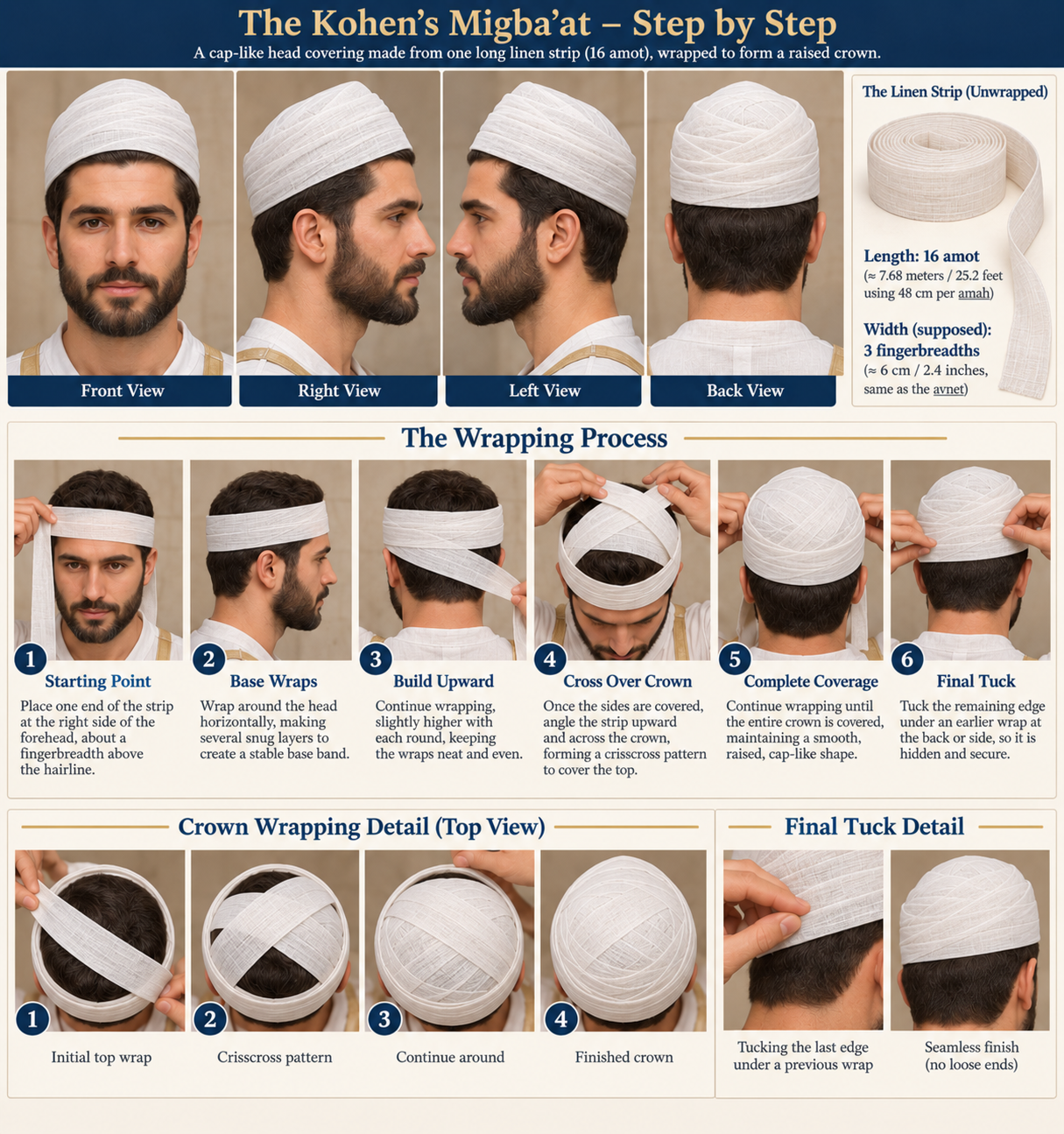
The Torah calls the head covering of Aaron’s sons the migba’at. Maimonides explains that the long headcloth of the ordinary Kohen was wrapped in a cap-like form.
Our reconstruction therefore does not use a large, loose turban or hanging fabric. The goal is a compact, raised, symmetrical and stable linen covering with the crown covered, ears visible and the front hairline exposed.
Maimonides gives the cloth a length of 16 amot. Using the 48 cm amah of Rabbi Chaim Naeh, this is approximately 7.68 meters.
- Material Fine white linen in one continuous strip.
- Length 16 amot — approximately 7.68 meters.
- Form Maimonides: the sons of Aaron wrap it “like a cap.”
- Height Some traditional explanations emphasize a raised, hill-like form.
The classical sources we are using specify the 16-amah length but do not give an explicit numerical width for the strip. For this visual reconstruction, we provisionally use a width close to three fingerbreadths—comparable to the sash—as a working design assumption, not as a stated halakhic measurement.
The body and garments function as one system
The priestly garments are not worn over ordinary layers of clothing. Where a garment is required to be worn against the Kohen, an unrelated garment may not intervene between the body and the priestly garment.
This does not mean that every inch of linen must cling continuously to the skin. A woven garment naturally contains functional space, particularly around moving parts of the body.
No unrelated interposition
The garments are worn in their prescribed relation to the body without ordinary clothing inserted beneath them.
Proper measure
The Kohen must be able to walk, bend, carry and work. Beauty that prevents service is not the beauty of priestly service.
A Kohen prepared for service
The garments do not stand alone. They are worn by a man who approaches sacred service clean, orderly and prepared.
A serving Kohen should not appear with neglected or overgrown hair. The visual reconstruction therefore presents healthy, evenly trimmed, natural hair—neither an artificial military cut nor an unkempt style.
Body, hair, garments and posture communicate one idea: a man standing ready to serve.
The Kohen serves barefoot
Even while dressed in beautifully made sacred garments, the Kohen stands on the sacred floor without shoes.
There is no contradiction. It expresses the relationship between dignity and humility: sacred garments above, direct contact with the place of service below.
The garments are not merely an external sign. For Temple service, their proper wearing is part of the active exercise of the priestly office.
The sources behind the reconstruction
This page distinguishes between details explicitly stated in the classical sources and visual decisions required to produce a complete reconstruction.
Open sources and reconstruction notes
- Exodus 28:2, 40–43 — “for honor and for beauty” and the garments of Aaron’s sons.
- Exodus 39:27–29 — manufacture of the tunics, head coverings, trousers and sash.
- Maimonides, Laws of the Temple Vessels, Chapter 8 — materials, measurements and construction of the priestly garments.
- Maimonides, Laws of the Temple Vessels, Chapter 10 — order of dressing, sash wrapping and head wrapping.
- Babylonian Talmud, Zevachim 17b — “When their garments are upon them, their priesthood is upon them.”
- Babylonian Talmud, Zevachim 19 — laws concerning interposition between the garments and the body.
When the classical sources specify a material, measurement or form, those details control the reconstruction. Where the sources do not preserve an exact visual detail— such as the precise shape of the ketonet neck opening or the width of the migba’at strip—we identify the solution as a reconstruction rather than as an explicit halakhic measure.
Bringing the Torah of Kehuna back into lived reality
Igud HaKohanim works in research, documentation, education and practical reconstruction of Israel’s priestly institution—grounded in the sources and presented with the dignity it deserves.
Support Israel’s Priesthood