
The Kohen’s Garments
For honor, beauty and sacred service.The priestly garments express purity, humility, service, cleanliness, discipline and beauty—not merely as external decoration, but as part of the Kohen’s service itself.
For honor and for beauty
The priestly garments are neither incidental work clothes nor theatrical costume. Their defining standard is honor and beauty.
“You shall make sacred garments… for honor and for beauty.”
Their beauty does not depend upon excessive decoration. It comes from exceptional material, precise weaving, spotless cleanliness, proper proportion, disciplined form and color only where prescribed.
The result is a distinctive visual language: splendor without ostentation, humility without poverty, and beauty entirely directed toward service.
The service uniform of Israel’s priesthood
The priestly garments are not scenery. They are a defined system of clothing worn by a man entering a sacred working environment in which every movement is directed toward service.
The Kohen stands, walks, lifts, carries, receives, gives and works. His garments therefore have to remain orderly, stable, modest and suitable for real physical activity.
Four garments. One function.
The ordinary serving Kohen wears four garments: the ketonet, michnasayim, avnet and migba’at. Together they form one disciplined system of priestly dress.
Ketonet
The principal white linen tunic, establishing most of the visible silhouette of the Kohen.
Michnasayim
The inner linen trousers of modesty and secure movement, largely concealed beneath the ketonet.
Avnet
The exceptionally long sash, wrapped repeatedly around the torso and bringing structure and color to the garments.
Migba’at
A long linen strip wrapped into a clean, raised and stable cap-like head covering.
The Ketonet
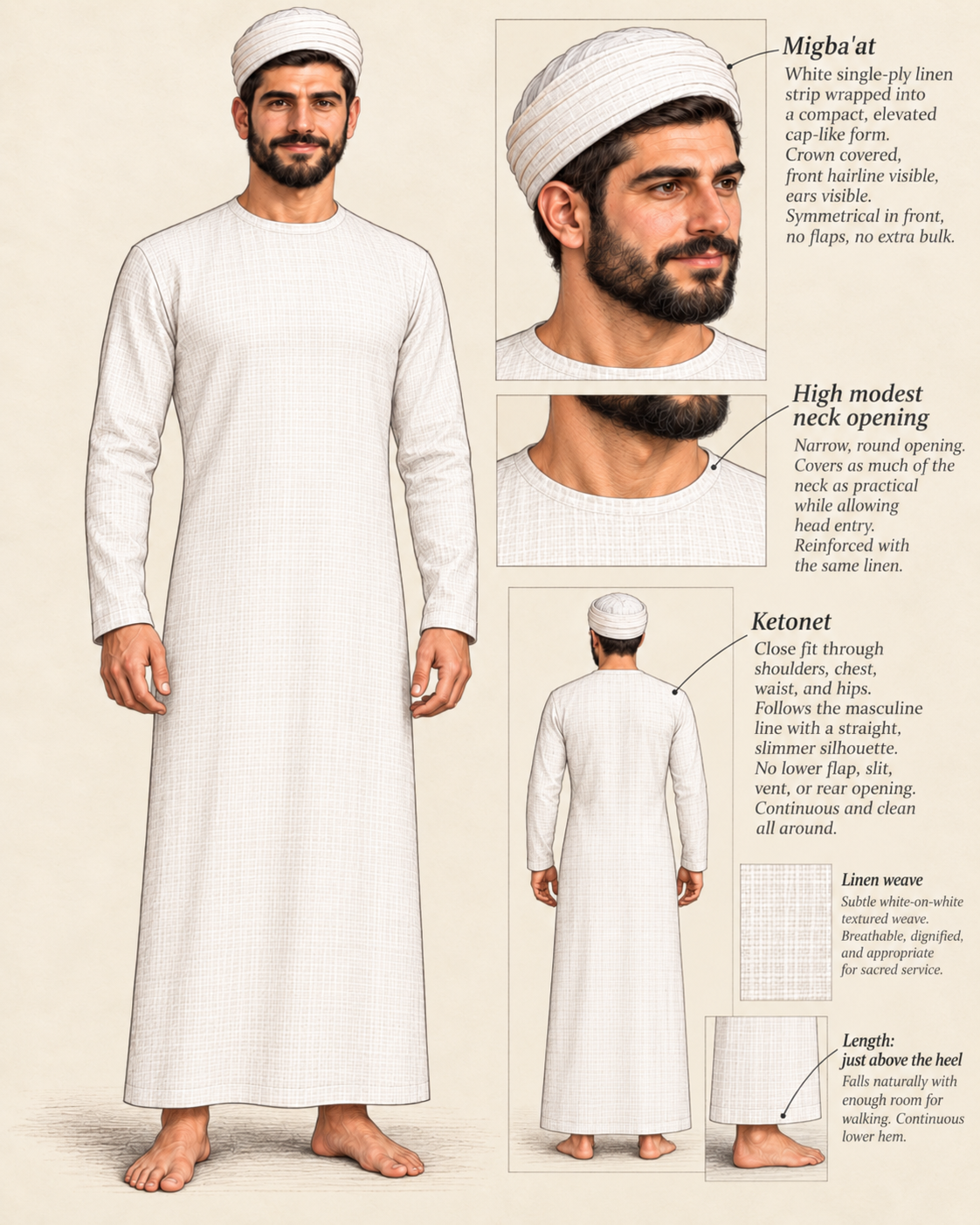
The ketonet is the principal outer garment of the ordinary Kohen: a long white linen tunic whose weave, proportion and cleanliness establish most of the visible character of the priestly garments.
The ketonet is meshubetzet—woven with small cells or compartments formed directly within the textile itself. The result is a subtle white-on-white texture, rather than applied decoration or an exaggerated checkerboard.
The garment is made to the Kohen’s measure. It should follow the shoulders, chest, waist and masculine hip line closely, with only the functional ease demanded by non-stretch woven linen and unrestricted movement during service.
Below the hips the garment falls naturally and opens only as much as required for walking, bending and working. The lower body remains continuous: no slit, flap, vent or decorative opening.
The neck opening in this reconstruction is intentionally high and modest: only large enough to permit the head to pass comfortably. It is finished with the same white linen to protect the edge from wear. The exact geometry and finishing method are a practical reconstruction; a modern collar or separate throat flap is not specified.
- MaterialFine white linen.
- WeaveSubtle woven-in meshubetz texture; white-on-white rather than applied ornament.
- NeckHigh, narrow and modest; no standing collar, buttons or decorative flap.
- FitIndividually proportioned with minimal functional ease; close through shoulders, torso and hips without restricting movement.
- SleevesFull length to the beginning of the hand, with controlled width around the arm.
- LengthIn its properly worn state, the hem falls just above the heel.
View the Michnasayim illustration Garment views, linen details and sixfold-yarn construction
The Michnasayim
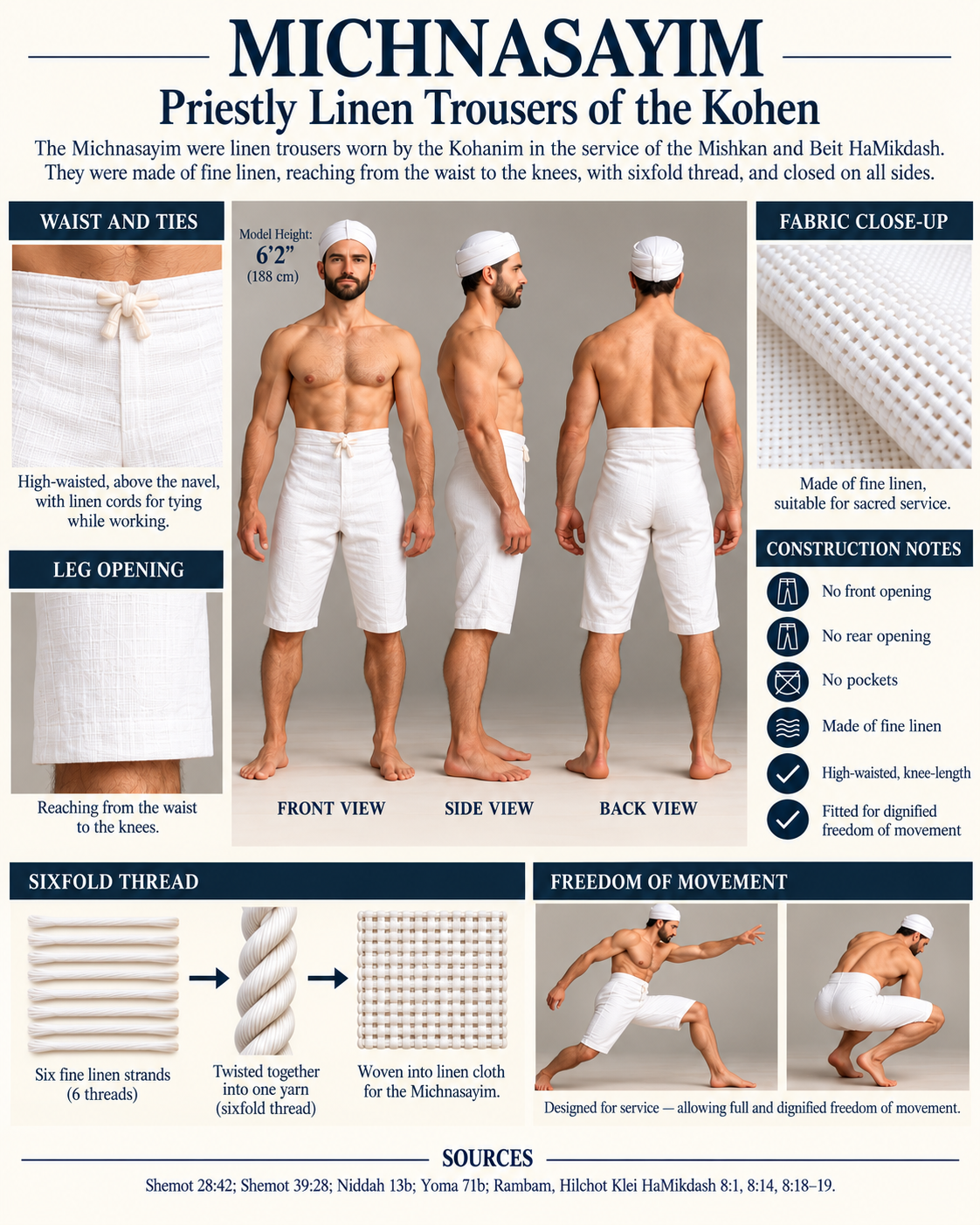
The michnasayim are the white linen trousers worn beneath the ketonet. They provide modest covering while allowing the Kohen to move freely and securely during sacred service. The illustration shows the trousers by themselves to reveal their construction.
The “ch” in michnasayim represents the Hebrew guttural sound heard in Bach or loch, rather than the “ch” in chair.
The garment is made from white linen, expressly intended to provide modest covering. Its fabric is described as שֵׁשׁ מָשְׁזָר—sixfold twisted linen. Its construction includes textile ties and no dedicated front or rear bodily opening.
The upper edge rises above the navel, toward the region of the heart; the lower edge reaches the knee (arkuvah). Shnatzim (linen ties) secure the garment. The form is mukafin k’min kis—an enclosed, pouch-like covering. This describes its structure, not a pocket for storing items.
The linen and sixfold thread: Each working yarn is composed of six fine linen strands combined into one sixfold thread and then woven into fabric. This does not mean six separate layers of cloth. Our depiction uses exceptionally fine, brilliant-white linen, of the same quality expected for the ketonet, with sufficient opacity and breathable structure. The specific meshubetz weave described for the ketonet is not independently specified for the trousers.
The fit: Our visual reconstruction gives the Kohen a secure high rise, knee-length legs and only the ease necessary through the seat and thighs for standing, walking and bending. The linen ties are just long enough for a firm knot, without loose ends. There is no fly, zipper, button or pocket. The short ties, absence of storage pockets, precise seam placement and chosen fabric density are reconstruction decisions rather than prescribed measurements.
- MaterialFine, exceptionally white, sufficiently opaque linen.
- YarnSix fine strands combined into one sixfold thread, not six layers of cloth.
- Upper edgeAbove the navel, approaching the region of the heart.
- Lower edgeAt the knee, the arkuvah.
- FasteningLinen shnatzim; in the illustration, only enough for a secure knot.
- ConstructionEnclosing form; no designated front or rear bodily opening.
- MovementA controlled silhouette with necessary functional ease, not excessive bagginess.
- Other detailsNo pockets or modern hardware—deliberate reconstruction choices.
The linen, sixfold yarn, rise, knee length, ties and absence of bodily openings are defined features. The exact cutting pattern, fabric density, short knot ends, absence of storage pockets and precise seam locations are visual reconstruction choices.
The Avnet
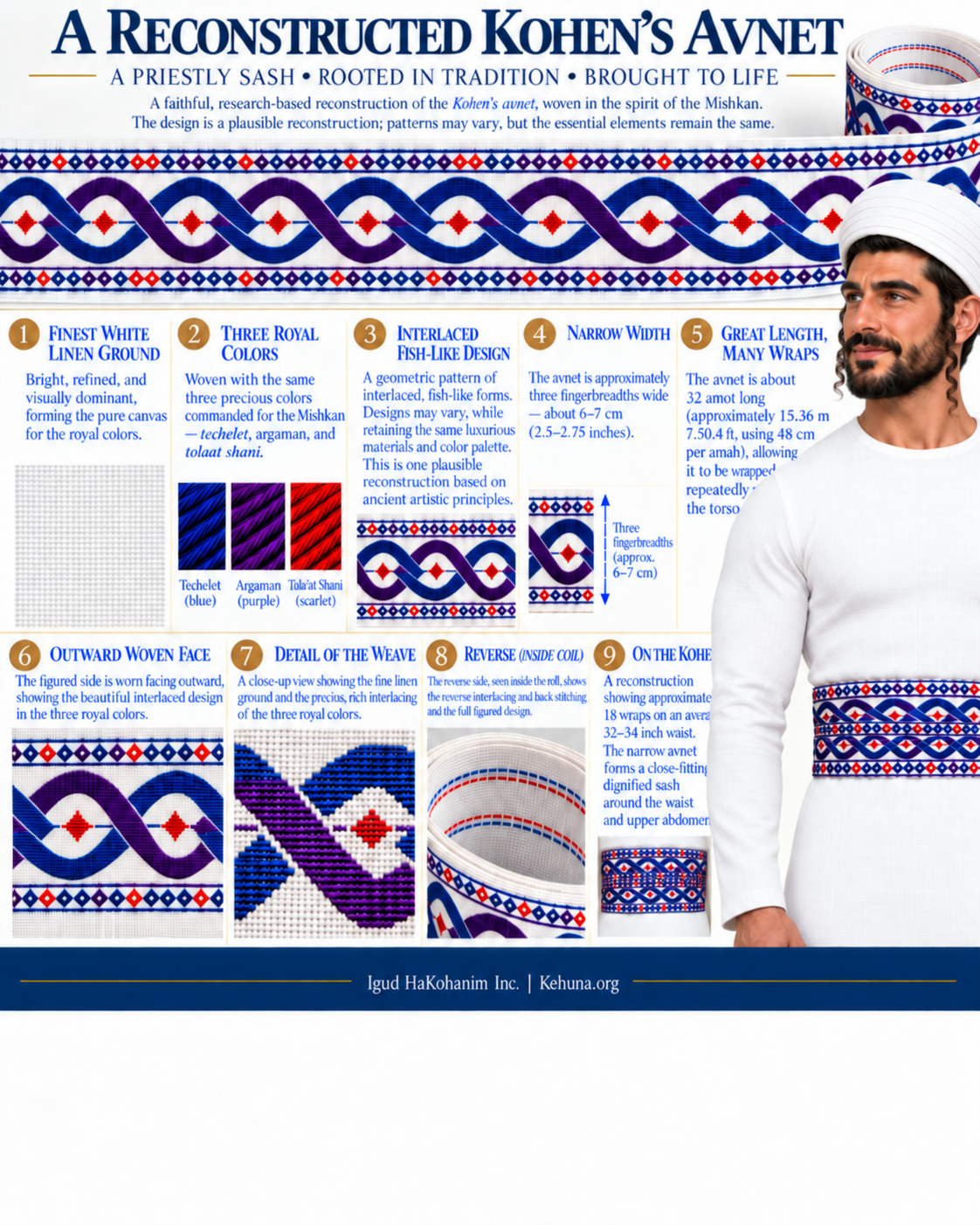
The avnet is the principal point at which the ordinary Kohen’s otherwise restrained white garments acquire concentrated color and structural definition. It is a remarkably long, narrow sash wrapped around the torso again and again until it forms a broad, orderly and stable girdle.
The avnet measures approximately three fingerbreadths wide and 32 amot long. It is wound around the torso layer upon layer, forming a broad, ordered girdle. With a 48 cm amah and a fingerbreadth of approximately 2 cm, its estimated dimensions are 15.36 meters by 6 centimeters. The conversion is approximate; the traditional measurements remain primary.
This extreme length should not be imagined as fabric hanging from the body. The sash is gathered into repeated, calibrated circuits around the torso. As one narrow layer follows another, the individual strip becomes a substantial horizontal girdle without requiring the strip itself to be unusually wide.
The ordinary Kohen’s garments are predominantly fine white linen; the avnet uniquely incorporates colored wool. Its figured textile work is woven into the sash itself, rather than applied afterward as ordinary needle embroidery. The colored threads of techelet, argaman and tola’at shani belong to its construction.
The visual reconstruction uses brilliant, exceptionally fine white linen together with techelet, argaman and tola’at shani in deep, saturated and precious hues: a profound blue-violet techelet, a dark wine-rich argaman, and a vivid scarlet-crimson tola’at shani.
The exact historic ornamental pattern of the ordinary Kohen’s avnet has not been preserved. The geometric motif shown here is therefore an artistic reconstruction, not a claim that this precise design was historically used. The image demonstrates the materials, color vocabulary, scale and repeated wrapping of the garment.
- Length32 amot — approximately 15.36 meters with a 48 cm amah.
- WidthApproximately three fingerbreadths — about 6 cm with a 2 cm fingerbreadth.
- GroundExceptionally fine, brilliant white linen.
- Colored workWool in techelet, argaman and tola’at shani, rendered in deep and saturated hues.
- ConstructionFigured woven work integrated into the textile, rather than conventional post-weaving embroidery.
- WrappingLayer upon layer, with no long decorative tail hanging from the body.
As a geometric illustration, a 15.36-meter sash wrapped around a torso circumference of approximately 32–34 inches yields roughly 18–19 complete circuits before accounting for differences in tension, position and final securing. This is not an additional garment specification; it demonstrates the physical effect of repeated wrapping.
The richly figured face is presented outward during wrapping, while the technical reverse of the weave remains within the layers. The exact historic pattern is unknown, and alternate designs using the same materials, dimensions and colors are possible.
The Migba’at
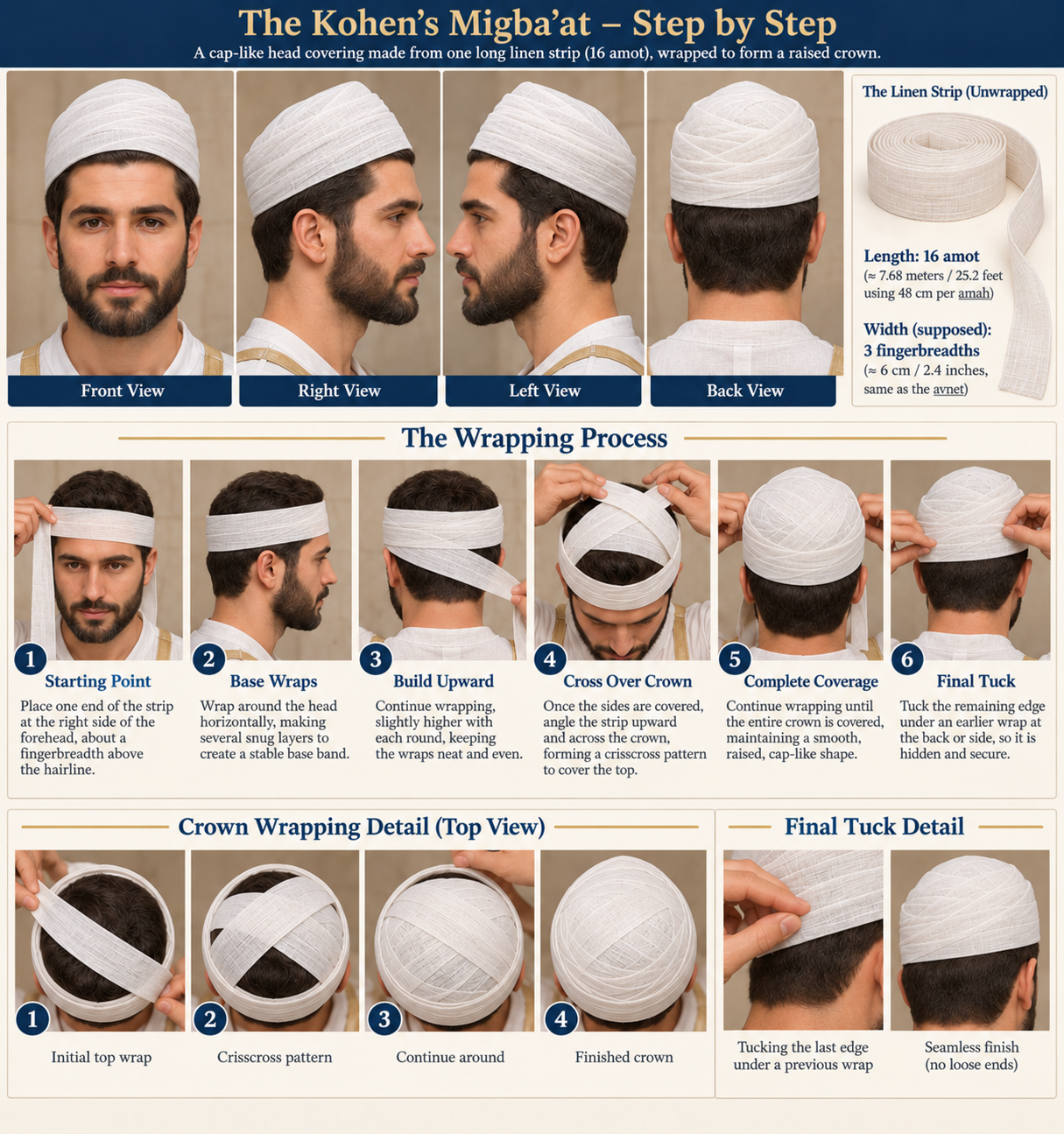
The migba’at is the ordinary Kohen’s white linen head covering. A long, continuous cloth is wrapped into a compact, cap-like form, with an orderly, raised profile and no hanging tail.
Our reconstruction does not use a large, loose turban or hanging fabric. The goal is a compact, raised, symmetrical and stable linen covering with the crown covered, ears visible and the front hairline exposed.
The cloth measures 16 amot—approximately 7.68 meters using a 48 cm amah.
- MaterialFine white linen in one continuous strip.
- Length16 amot — approximately 7.68 meters.
- FormWrapped into a stable, compact cap-like form.
- HeightA raised profile, rather than a loose or flat covering.
The cloth length is specified, but an exact numerical width has not been established. The illustration uses a width close to three fingerbreadths as a working design assumption, not as an additional prescribed measurement.
The body and garments function as one system
The priestly garments are not worn over ordinary layers of clothing. Where a garment is required to be worn against the Kohen, an unrelated garment may not intervene between the body and the priestly garment.
This does not mean that every inch of linen must cling continuously to the skin. A woven garment naturally contains functional space, particularly around moving parts of the body.
No unrelated interposition
The garments are worn in their prescribed relation to the body without ordinary clothing inserted beneath them.
Proper measure
The Kohen must be able to walk, bend, carry and work. Beauty that prevents service is not the beauty of priestly service.
A Kohen prepared for service
The garments do not stand alone. They are worn by a man who approaches sacred service clean, orderly and prepared.
A serving Kohen should not appear with neglected or overgrown hair. The visual reconstruction presents healthy, evenly trimmed, natural hair—neither an artificial military cut nor an unkempt style.
Body, hair, garments and posture communicate one idea: a man standing ready to serve.
The Kohen serves barefoot
Even while dressed in beautifully made sacred garments, the Kohen stands on the sacred floor without shoes.
It expresses the relationship between dignity and humility: sacred garments above, direct contact with the place of service below.
The garments are not merely an external sign. For Temple service, their proper wearing is part of the active exercise of the priestly office.
The sources behind the reconstruction
The historical and textual foundations, measurement conventions and reconstruction decisions are documented here separately from the article.
Open bibliography and reconstruction notes
- Exodus 28:2; 28:40–43 — Honor, beauty, the priestly garments and the purpose of the linen trousers.
- Exodus 39:27–29 — Textile manufacture, including shesh mashzar for the trousers.
- Babylonian Talmud, Niddah 13b — Coverage, the form of the trousers, ties and the absence of designated bodily openings.
- Babylonian Talmud, Yoma 71b–72b — Sixfold yarn and principles of woven construction.
- Babylonian Talmud, Zevachim 17b; 18b–19a — The relationship between the priestly garments, service and the body.
- Maimonides (Rambam), Mishneh Torah, Hilchot Klei HaMikdash veHaOvdin Bo 8:1, 4, 14, 16, 18–19; 10:1 — Materials, dimensions, weave, trousers, sash, head covering and manner of wearing.
- Maimonides, Peirush HaMishnah, Kelim 27:6, Judeo-Arabic edition of R. Yosef Qafih — A reference for garment terminology; the precise sewing pattern is not established by this citation.
- Malbim, commentary on Leviticus 6:3 — Discussion of bad and shesh terminology.
- Modern unit conversions — The metric estimates use a 48 cm amah and an approximately 2 cm fingerbreadth, associated with the measurements of R. Chaim Naeh. These estimates are illustrative, not additional garment specifications.
Explicit prescriptions for materials, dimensions, ties and openings are distinguished from interpretive decisions such as exact tailoring, knot length, ornament, weave density and the width of the headcloth. The imagery documents a considered reconstruction rather than a surviving historical pattern.
Bringing the Torah of Kehuna back into lived reality
Igud HaKohanim works in research, documentation, education and practical reconstruction of Israel’s priestly institution—grounded in the sources and presented with the dignity it deserves.
Support Israel’s Priesthood