Should a Kohen Bless the Baby After a Brit or Pidyon HaBen?
Should a Kohen Bless the Baby After a Brit or Pidyon HaBen?
A distinction between formal Birkat Kohanim and a personal blessing by a Kohen helps explain both the longstanding customs and the concerns raised about adding the Priestly Blessing to a family ceremony.
The Question
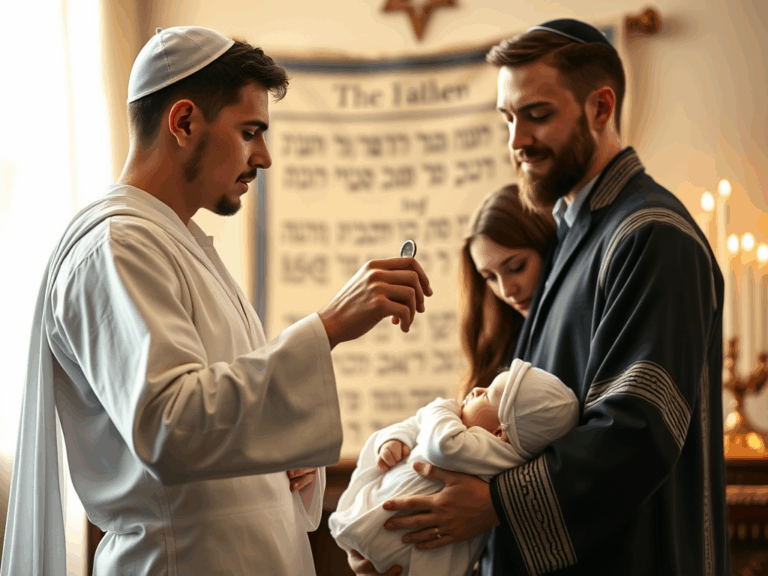
In some communities, particularly among Sephardi and Chassidic families, a Kohen may bless a newborn following a Brit Milah. A Kohen who serves as the mohel may feel that it is especially natural to bless the child after completing the mitzvah.
Other communities do not include such a blessing in the order of the brit. A Kohen may therefore be told that Birkat Kohanim is simply not part of the procedure and should not be added.
At a Pidyon HaBen there is considerably stronger textual precedent for the Kohen to place his hand upon the child and bless him. The question is therefore not simply whether a Kohen may ever use the verses of Birkat Kohanim. We first have to ask what kind of blessing he is giving and how that blessing arises.
Formal Nesiat Kapayim Is Not the Same as a Personal Blessing
The Torah gives the Kohanim a defined commandment to bless Israel. In its formal expression, Birkat Kohanim — also called Nesiat Kapayim — has a recognizable order and form: the Kohanim stand, face the people, raise their hands, and pronounce the three Torah verses of blessing.
A Kohen who places one hand upon a child’s head and uses those same verses as a personal prayer and blessing is doing something visibly different. He is not presenting himself as performing another formal duchaning. That distinction allows us to understand longstanding family customs without automatically treating every private use of the verses as another formal performance of Nesiat Kapayim.
The Words God Gave the Kohanim
The Torah commands Aharon and his sons to bless the Children of Israel and gives them the words of the blessing.
יָאֵר ה׳ פָּנָיו אֵלֶיךָ וִיחֻנֶּךָּ
יִשָּׂא ה׳ פָּנָיו אֵלֶיךָ וְיָשֵׂם לְךָ שָׁלוֹם
These words therefore have an obvious place in the vocabulary of priestly blessing. The question at a brit or Pidyon HaBen is not whether they are words of blessing. The question is whether they are being used as formal Nesiat Kapayim or as a personal blessing given at a significant moment in the child’s life.
A Strong Early Precedent
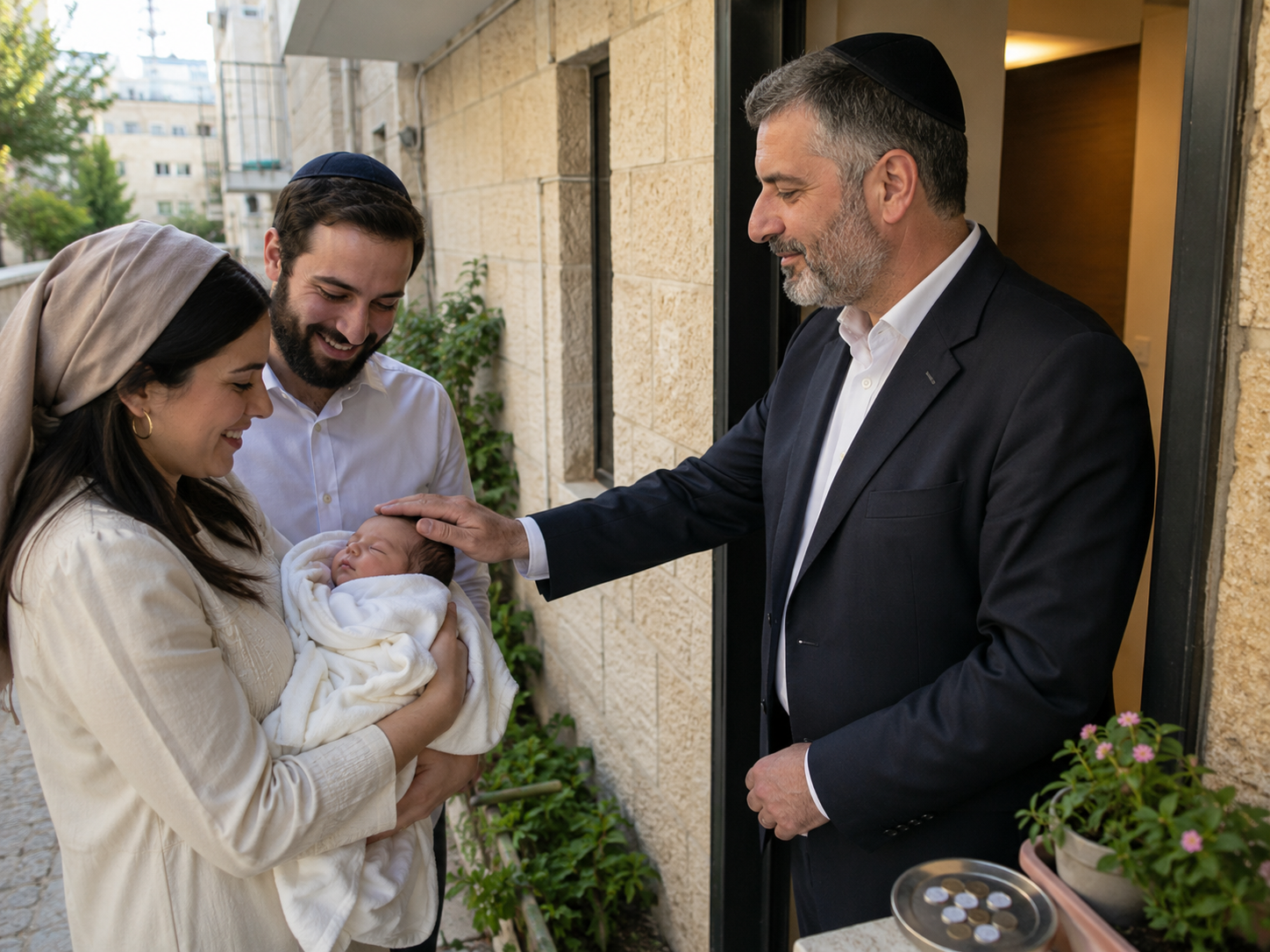
Regarding Pidyon HaBen, an early source quoted by the Rashba in the name of Rabbeinu Chananel describes the Kohen, after the redemption, placing his hand upon the child’s head and blessing him.
The source then gives יברכך ה׳ and other verses of blessing as examples. Related forms of the practice are also recorded in the Abudarham and Kol Bo.
This is significant. The practice is not dependent upon a guest spontaneously deciding that it would be nice for the Kohen to bless the child. There is an established textual tradition for the Kohen himself to give a personal blessing following the redemption.
What About After a Brit Milah?
The case of Brit Milah is less direct. Some communities have a custom for a Kohen to bless the newly circumcised child, while other communities do not include this in the order of the ceremony. Accordingly, a rabbi who says that Birkat Kohanim is not part of the brit procedure is making an intelligible distinction.
At the same time, the existence of a community custom can be understood without turning the blessing into another formal Nesiat Kapayim. A Kohen — including a Kohen who is himself the mohel — may give the child a personal blessing using the Torah’s words, where that is his custom or his own desire.
The fact that the mohel happens to be a Kohen does not make such a blessing an obligatory stage of milah. It can, however, give the practice an especially natural expression: a Kohen has just personally participated in bringing the child through a major covenantal mitzvah and then, of his own volition, turns to bless him.
Does the Child Only Become Part of “Bnei Yisrael” After the Brit?
No. That cannot be the reason for placing the blessing after the circumcision. A Jewish child is already part of Israel before the milah. Being uncircumcised does not remove him from Bnei Yisrael.
If the blessing is given afterward, its timing is better understood as honoring the completion of the mitzvah and the covenantal moment that has just taken place — not as though the child only now became Jewish or only now became eligible to receive a blessing.
Milah, Korban, and Aharon’s Blessing
There is an additional conceptual connection worth considering. Rabbeinu Bachya explicitly describes Brit Milah as resembling a korban. He compares the blood of milah to the blood of an offering, connects the eighth day of circumcision to the eighth day from which an animal becomes fit for an offering, and relates the festive meal of the brit to the eating associated with offerings.
That makes Aharon’s blessing after the avodah particularly striking:
The Talmud itself uses this episode in developing the laws of Nesiat Kapayim and its relationship to avodah.
It is therefore reasonable to see a meaningful parallel: a sacred act has been completed, and blessing follows. We would present this as a conceptual rationale for the custom, not as proof that this verse was historically the source from which the custom developed.
Three Different Ways a Blessing Can Arise
It is useful to distinguish between demanding a blessing, inviting one, and simply leaving the Kohen free to offer one on his own. These are not equivalent.
Demanding the Blessing
The strongest form of pressure is to tell the Kohen that he must bless the child, to insist upon it, or to present the request as though the family or a guest has a right to receive a private blessing from him.
The obligation of a Kohen to participate in formal Nesiat Kapayim should not automatically be extended into a claim that any private individual can require an additional personal blessing at a family ceremony. We have not found a source establishing such a private right of compulsion.
Inviting the Kohen to Bless
A polite request is very different from a demand, and there is nothing inherently improper about asking whether the Kohen would like to bless the child.
Still, even an invitation can carry some degree of social pressure. If it is made publicly, while everyone is watching and the child is already being held out before the Kohen, declining may become uncomfortable even though the words used were technically polite.
Where a family specifically wishes to include such a blessing, a better approach is to discuss it quietly with the officiating Kohen beforehand and allow him to decide whether it accords with his practice.
The Kohen Blesses on His Own Initiative
The cleanest expression of a personal blessing is when the Kohen himself chooses to bless the child, whether because that is his established custom, because it is part of the ceremony he has agreed to perform, or because he feels moved at that moment to do so.
In that setting there is no need to wonder whether the blessing was produced by social expectation. It arises naturally from the Kohen and from his desire to invoke God’s blessing upon the child.
Asking for a Blessing Is Not Itself Improper
The distinction should not be pushed too far in the other direction. Jews commonly ask parents, teachers, Kohanim, and respected people for blessings. The fact that someone was asked does not make the blessing insincere or meaningless.
Much depends upon how the request is made and whether the Kohen remains genuinely free to say yes or no. A quiet invitation offered in advance is very different from an expectation announced in front of a roomful of guests.
If the Kohen declines, nothing more should be made of it. The goal is to preserve the dignity of the blessing, not to turn a personal act of goodwill into an obligation created by the audience.
A Broader Torah Sensitivity to Pressure
There is a broader principle worth noticing, although it should not be confused with a direct law of personal blessings. In the laws of priestly gifts, circumstances can matter when judging whether a Kohen’s apparent consent is truly voluntary. For example, the sources take account of an employment relationship where the Kohen may feel pressured to designate his gifts in accordance with his employer’s wishes.
That rule concerns property and priestly gifts, not the spiritual validity of a blessing. It does, however, illustrate that Torah law is capable of distinguishing between an outwardly expressed agreement and a choice made under subtle dependence or pressure. It reinforces the prudence of allowing a personal blessing to remain genuinely personal.
How the Distinction Can Be Preserved
At a Pidyon HaBen
There is substantial traditional precedent for the Kohen to place his hand upon the child and bless him after the redemption, including with the verses beginning יברכך ה׳ וישמרך. Where this is the officiating Kohen’s accepted practice, it can simply be allowed to occur naturally as part of the ceremony.
At a Brit Milah
Where the community or Kohen has such a custom, the child may be blessed as a personal blessing. If the family wishes to request it, discussing it privately in advance is preferable to placing the Kohen on the spot during the ceremony.
Where There Is No Custom
There is no reason to turn the blessing into a required additional stage of every Brit Milah. A community that has not practiced it need not regard the ceremony as incomplete without it, nor should a Kohen be pressured to introduce it.
Preserve the Blessing — and Preserve Its Voluntary Character
At a Pidyon HaBen, there is substantial traditional precedent for the Kohen to place his hand upon the child and bless him with the verses of Birkat Kohanim and other verses of blessing.
At a Brit Milah, some communities likewise have a custom for a Kohen or Kohen-mohel to bless the child. Where this is done, the blessing should be understood as a personal blessing using the Torah’s words, rather than as an additional formal performance of Nesiat Kapayim outside its established setting.
The manner in which the blessing arises also matters. Demanding a personal blessing from a Kohen is inappropriate. Inviting him to give one is different and may be entirely respectful, but even an invitation can create pressure depending upon how and when it is made.
The most natural setting is one in which the Kohen remains free to act according to his own practice and volition. If a family wishes to include the blessing, it is preferable to discuss the matter privately beforehand rather than creating an expectation in front of the assembled guests.
Principal Sources
- Bamidbar 6:23–27 — the Torah command and text of Birkat Kohanim.
- Vayikra 9:22 — Aharon raises his hands and blesses the people after the avodah.
- Sotah 38a–b — the form of Nesiat Kapayim and its connection to Aharon’s blessing and avodah.
- Shulchan Aruch, Orach Chaim 128 — the public performance of Birkat Kohanim and the Kohen’s obligations within that framework.
- Biur Halacha to Orach Chaim 128 — discussion of the formal performance of Birkat Kohanim and adding to the mitzvah.
- Responsa Rashba I:200, citing Rabbeinu Chananel — the Kohen places his hand on the child after Pidyon HaBen and blesses him; related practice is also recorded by the Abudarham and Kol Bo.
- Rabbeinu Bachya, Bereshit 17:13 — Brit Milah described as analogous to a korban, including the blood, eighth day, and celebratory meal.
Continue Studying
The Priestly Blessing
Study the Torah commandment through which the Kohanim place God’s Name upon His people Israel.
Study Birkat KohanimPidyon HaBen
Learn the role of the Kohen, the five silver shekels, and the redemption of the qualifying firstborn.
Study Pidyon HaBenCustoms of Pidyon HaBen
Review the ceremony text, blessings, festive meal, and customs surrounding the redemption.
Review the CeremonyHave a Question About Birkat Kohanim or Pidyon HaBen?
Igud HaKohanim welcomes source material and practical questions concerning the living responsibilities and traditions of the Kohanim.
Contact Igud HaKohanim