
Garment Nega’im | Colors, Materials and the Kohen’s Viewing Process
The Torah’s laws of nega’im do not stop with the human body. Wool, linen and leather enter their own detailed system of colors, inspection, quarantine, laundering and final determination — and the Kohen is expected to know what he is looking at.
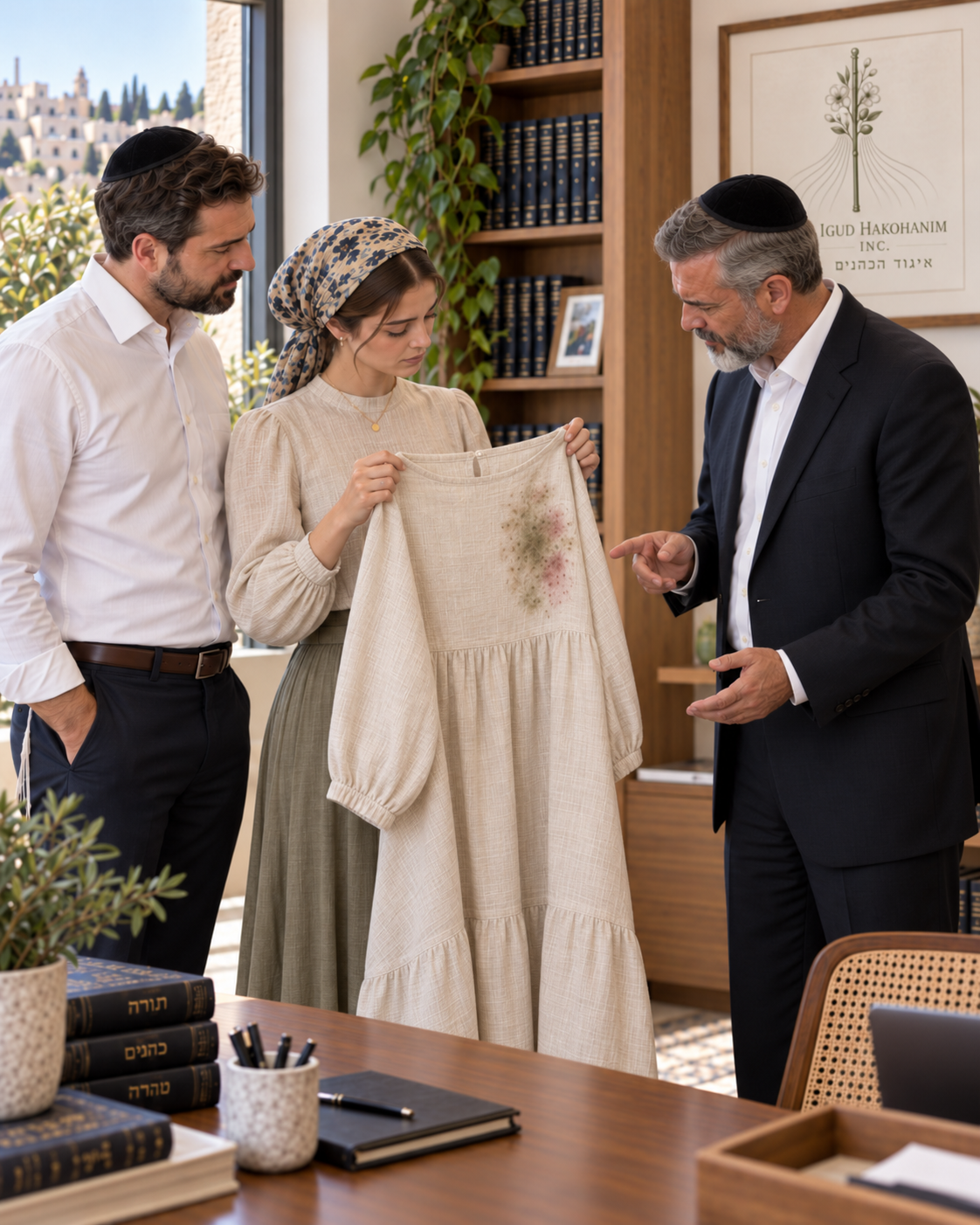
The Kohen is expected to know the whole field
Chazal speak about a Kohen who knows the laws of skin and house nega’im but does not know the laws of garment nega’im. Such partial knowledge does not qualify him as someone capable of viewing all nega’im.
The standard is strict — but it is not unattainable. Garment nega’im follow a structured process. The place to begin is to learn what materials qualify, what colors matter, what changes are significant, and what the Kohen actually does when an affected article is brought before him.
A garment nega is not simply any stain on any piece of clothing. The Torah limits the category by material, color, dimensions and process. Those limitations are what make the Kohen’s task precise and learnable.
What can receive a garment nega?
The Torah’s nega’im framework extends beyond בני ישראל themselves. Qualifying garments — and qualifying objects made from the same materials — may also become the subject of a nega.
The basic framework presented by the classical sources centers on non-dyed wool and linen, together with qualifying leather. The detailed rules concerning dyed leather are the subject of a separate tannaitic dispute, discussed below.
Wool
Qualifying wool garments and woolen vessels or articles may receive a nega.
Linen
Linen garments and qualifying linen articles are included in the Torah’s garment-nega framework.
Leather
Certain leather articles qualify as well, although the status of dyed leather is disputed.
Bags, containers, seating and other usable objects made of qualifying wool, linen or leather may enter the same framework. The source tradition for these material categories is developed in the Sifra to Parashat Tazria.
A garment nega is a serious Torah status
Once a garment receives the status of a nega, it is treated as an אב הטומאה.
Rabbi Yosi HaGelili’s reading in the Sifra places the affected garment outside the walled city in Eretz Yisrael, corresponding to the concept of מחוץ לשלש מחנות. The Minchas Chinuch discusses an even broader possibility: removal from a city even outside Eretz Yisrael.
Why are the susceptible materials so limited?
If the Torah limits garment nega’im to particular kinds and colors of material, one may at least ask whether there is an implied lesson: should a person deliberately choose clothing that remains capable of displaying the Torah’s sign, rather than attempting to “fly under the radar” of the laws of nega’im? This is a question for thought, not a rule stated by the source.
The two colors: ירקרק and אדמדם
The Torah names two principal garment-nega colors: ירקרק and אדמדם.
The Sifra and Mishnah understand ירקרק as ירוק שבירוקין, and אדמדם as אדום שבאדומים.
At the same time, the doubled forms ירקרק and אדמדם generated an important linguistic discussion over whether they indicate intensity, approximation, or a more precise exclusion of fringe shades. The philological sources are preserved in the notes below.
ירקרק — what kind of green?
The Tosefta records two approaches. Rabbi Elazar ben Shamua HaKohen associates ירקרק with the yellow color of beeswax and the yellow of an egg.
Sumchus describes it through the wing of a peacock and the leaves of a date palm.
אדמדם — how red is red?
Chazal describe the Torah’s אדמדם as אדום שבאדומים.
Of note, the definition is not simply אדום כדם. Blood itself may appear in shades classified differently, including blackened blood in the laws of niddah.
The natural examples preserved by Chazal


Real-world colors
These examples suggest that the classical discussion is anchored in recognizable natural colors rather than artificial modern hues. According to this approach, ירוק שבירוקין need not mean a neon or unusually fluorescent “maximum green.”
Rabbi Yechiel Michel HaLevi Epstein, in Aruch HaShulchan HeAtid, explains the language of ירוק שבירוקין as excluding alternative shades that may sometimes be called green, such as blue.
Likewise, אדום שבאדומים can be understood as excluding colors that can sometimes fall under a broader red category, such as blackened blood — recalling Chazal’s statement: האי שחור אדום הוא אלא שלקה.
This provides a striking way to reconcile two readings of the doubled words: they may be “superlative” not because they demand the most extreme imaginable green or red, but because they identify the recognizable core hue while excluding fringe colors that could otherwise be described by a broader term.
On this reading, the Kohen’s viewing range may include qualifying lighter or fainter forms of recognizable green and red.
A possible visual comparison for אדמדם

The Kohen’s viewing process
The process for wool, linen and qualifying leather is structured. The affected article is brought to the Kohen. The Kohen sees the relevant green or red appearance and begins the Torah-prescribed sequence.
From first viewing to final determination
First viewing
The affected garment or article is shown to the Kohen. A qualifying appearance does not ordinarily receive an immediate final verdict.
Seven-day quarantine
The article is quarantined for seven days.
Second viewing — during the daytime
On the seventh day the Kohen views the article again. The viewing is performed during the day.
If the nega spread
If the appearance increased in size, or another nega appeared elsewhere on the garment or vessel, the article reaches the Torah’s severe outcome and is burned.
If the size remained unchanged
The article is laundered and then quarantined for another seven days.
An unusual rule: Rabbi Yonatan ben Avtulmus teaches that if a garment nega expands until it covers the entire garment, the garment becomes טהור. This teaching is cited in Niddah 19a.
The Kohen’s task is not to search for tumah
The Torah does not appoint the Kohen to condemn an article at first sight. His responsibility is to see accurately, wait when the Torah requires waiting, recognize change, and declare the correct status.
The same Kohanic office that can establish טומאה must also recognize when the Torah’s process leads toward טהרה. Accuracy cuts in both directions.
Garment nega’im therefore illustrate something broader about Kehuna: authority is joined to knowledge, patience and service to Israel.
Laundering is part of the Torah process
Both the green and red appearances are treated by the Torah as potentially removable through cleaning. If the first quarantine does not show spread, the Kohen commands that the affected article be washed:
וְצִוָּה הַכֹּהֵן וְכִבְּסוּ אֵת אֲשֶׁר בּוֹ הַנָּגַע
The source tradition presented here treats this as a prescribed cleaning process rather than merely ordinary household laundry. The earlier study material describes the cleaning as using a prescribed seven-ingredient formula.
What is פחתת?
The green or red appearance may respond to laundering. But if the ירקרק or אדמדם remains stubbornly in place, the Torah calls the condition פחתת and the garment is burned.
The Torah VeHaMitzvah commentary to the Sifra, Tazria 173, understands פחתת as describing the nega penetrating through the thickness of the fabric rather than remaining merely superficial.
וְרָאָה הַכֹּהֵן אַחֲרֵי הֻכַּבֵּס אֶת הַנֶּגַע וְהִנֵּה לֹא הָפַךְ הַנֶּגַע אֶת עֵינוֹ וְהַנֶּגַע לֹא פָשָׂה טָמֵא הוּא בָּאֵשׁ תִּשְׂרְפֶנּוּ פְּחֶתֶת הִוא בְּקָרַחְתּוֹ אוֹ בְגַבַּחְתּוֹVayikra 13:55
Dimensions, mixtures and objects
Leather: dyed or not?
Leather introduces additional variables. The material must come from qualifying land creatures; the source framework includes land animals and reptiles while excluding leather derived from sea creatures.
Leather laces are exempt, while a tent enclosure made from leather may qualify.
The status of dyed leather is disputed:
| Authority | Position |
|---|---|
| Rabbi Meir | The affected leather must be white — non-dyed leather only. |
| Rabbi Yehuda | Dyed leather is also included among materials eligible for nega’im. |
| Rabbi Shimon | Leather in any of its natural shades and colors qualifies, while artificially dyed leather does not. |
Do these features resemble fungal growth?
Green and red growths can occur on textiles and other materials. Several characteristics of the Torah’s garment-nega process invite comparison with the behavior of fungal growth.
First, the ירקרק or אדמדם can be laundered and may disappear.
Second, פחתת is understood in the source cited above as describing penetration through the material rather than a merely superficial mark.
Third, the discoloration can undergo פסיון — expansion.
A related observation arises from terminology used by clothing and house nega’im. The terms פחתת and שקערורת are used in those material settings rather than for ordinary skin discoloration.
The original Kehuna.org analysis understood these terms as pointing toward a phenomenon that penetrates or develops within the affected material.
The term ממארת is also distinctive in the clothing and real-estate discussions. The earlier analysis understood the word as suggesting an infective process extending beneath the visible surface.
On this reading, the return of a nega after laundering or planing may be significant even when its visible dimensions have not increased, because underlying development may have occurred beneath the surface. The earlier article points here to Torah VeHaMitzvah to Sifra Metzora 104.
The original investigation therefore proposed comparing the Torah’s two color families with green fungal growth and red fungal growth, and specifically mentioned Aspergillus versicolor in connection with the latter discussion.
What the Kohen is actually learning
At first glance, garment nega’im can appear highly technical. But the structure is remarkably concrete:
Which material is this? Is its color within the Torah’s ירקרק or אדמדם range? Is the article large enough? Did the appearance spread? Did laundering change it? Did it return?
These are demanding standards, but they are observable standards. The Torah expects the Kohen to learn them, know their names, recognize their signs and follow the viewing process carefully.
Sources, linguistic notes and extended discussion
1. Materials and susceptibility
- Sifra, Tazria, chapter 160 — source cited for the qualifying wool, linen and leather framework and for useful articles made from those materials.
- The original article emphasized white, non-dyed wool and linen, while treating leather separately because of the tannaitic dispute concerning dyed leather.
- A qualifying article can include bags, containers, seating and related useful objects made from the relevant materials.
2. Status of an affected garment
- Rabbi Yosi HaGelili, Sifra, Tazria, beginning of chapter 159 — cited for the removal of the affected garment outside the walled city, מחוץ לשלש מחנות.
- Minchas Chinuch — cited in the original article as taking the question further and discussing removal from a city even in Chutz La’Aretz.
- See Kehuna.org’s earlier listing of walled cities from the era of Yehoshua bin Nun ↗
3. ירקרק, אדמדם and the doubled-root debate
- The Sifra and Mishnah understand ירקרק as ירוק שבירוקין and אדמדם as אדום שבאדומים.
- Maharsha to Sotah 12b and Ibn Ezra to Vayikra 13:49 are cited for the linguistic significance of the apparent redundancy in ירקרק. The grammatical phenomenon is described by the בעלי דקדוק as כפל עי״ן למ״ד.
- Ibn Ezra to Shir HaShirim 1:6 gives a related explanation, and Rashi there is noted as pointing in a similar direction.
-
In Yesod Moreh,
Ibn Ezra’s linguistic logic is described as treating
doubled
עי״ן למ״ד
letters of roots such as
ח ט ג ז ע ס פ ר צ ד ק
as capable of creating an approximate or descriptive
suffix — comparable to English “-ish” —
while redundancy in
פ״א עי״ן
can imply a superlative.
Yesod Moreh reference ↗ - The original analysis compares this broader interpretive logic to the rabbinic rule of מיעוט אחר מיעוט ↗ , where repeated limitation can produce a broader result.
-
Dunash ben Labrat,
in responsum 35,
explains
ירקרק
in a non-superlative sense —
effectively “greenish.”
This view is quoted by Rashi to Tehillim 68:14.
Responsa of Dunash, section 35 ↗ -
Rabbi Yonah Ibn Janah,
Sefer HaShorashim, p. 360,
is cited for the explanation that Hebrew speakers
can use the redundant form to communicate
an approximate description.
Sefer HaShorashim reference ↗
4. Tosefta color comparisons
- Rabbi Elazar ben Shamua HaKohen — ירקרק is compared with beeswax and egg yolk.
- Sumchus — compares the color with a peacock’s wing and the leaf of a date palm.
-
The Tosefta’s expression
זהורית יפה שבים
is cited in the discussion of the red color.
Tosefta Nega’im 1:3 reference ↗
5. Aruch HaShulchan HeAtid
Rabbi Yechiel Michel HaLevi Epstein is cited for the explanation that ירוק שבירוקין excludes alternative hues that may sometimes be called green, such as blue, and that אדום שבאדומים similarly excludes fringe colors that can enter a broad “red” category.
The original article connects this with the statement in the laws of niddah: האי שחור אדום הוא אלא שלקה .
6. Laundering and פחתת
- Vayikra instructs: וצוה הכהן וכבסו את אשר בו הנגע .
- Torah VeHaMitzvah to Sifra Tazria 173 — cited for understanding פחתת as penetration through the thickness of the material.
-
Vayikra 13:55:
וְרָאָה הַכֹּהֵן אַחֲרֵי הֻכַּבֵּס אֶת הַנֶּגַע וְהִנֵּה לֹא הָפַךְ הַנֶּגַע אֶת עֵינוֹ וְהַנֶּגַע לֹא פָשָׂה טָמֵא הוּא בָּאֵשׁ תִּשְׂרְפֶנּוּ פְּחֶתֶת הִוא בְּקָרַחְתּוֹ אוֹ בְגַבַּחְתּוֹ
- The earlier study material describes the laundering process as a prescribed “seven-ingredient” cleaning formula.
7. Viewing process
- Initial viewing by the Kohen is followed by a seven-day quarantine.
- The Kohen views the article again on the seventh day, during daytime.
- Spread of the nega, or the appearance of another nega elsewhere on the article, leads to burning.
- If the nega remains the same size, the article is laundered and quarantined for another seven days.
- Rabbi Yonatan ben Avtulmus, Niddah 19a — cited for the remarkable rule that where the nega spreads over the entire garment, the garment becomes טהור.
8. Mixtures, dimensions and leather
- Wool-linen כלאים can qualify.
- The original source notes that where wool/linen forms the majority, other fibers may constitute the remaining 49%.
- Minimum garment dimension given: three by three fingerbreadths.
- Wool or linen strings are exempt.
- Leather from land animals — including reptiles — is included; leather from sea creatures is excluded.
- Leather laces are exempt, while a leather tent enclosure can qualify.
- Rabbi Meir — white, non-dyed leather only.
- Rabbi Yehuda — dyed leather is also included.
- Rabbi Shimon — natural leather colors qualify, artificially dyed leather does not.
9. The fungal-growth observation
The original Kehuna.org analysis drew attention to three physical features: the nega can potentially be removed through laundering; it can undergo פסיון; and פחתת suggests penetration into the material.
It further compared פחתת in garments with שקערורת in house nega’im, observing that both terms describe a material phenomenon rather than merely a superficial skin discoloration.
The distinctive term ממארת was likewise understood in the original analysis as implying an infective or spreading process.
Torah VeHaMitzvah to Sifra Metzora 104 is cited in connection with the significance of a nega returning after laundering or planing even where the visible dimensions remain unchanged.
The original article therefore proposed green and red fungal growth as possible modern physical comparisons and specifically named Aspergillus versicolor in the red-fungal-growth discussion.
This remains presented here as Kehuna.org’s observational hypothesis rather than as an identification stated by Chazal.
Support the Study of Kehuna
Igud HaKohanim works to restore serious knowledge of the Torah responsibilities entrusted to the descendants of Aharon — including areas that have become unfamiliar simply because they are rarely studied in practical terms.
Support Igud HaKohanim