
Deeper Study · The Kosher Consumer
When the Priestly Gifts Were Not Given
What should a kosher consumer understand when the Zeroa, Lechayayim and Keva were not separated and delivered to a Kohen?
The practical ruling permits the remainder of the meat. The actual Zeroa, Lechayayim and Keva remain the Kohen’s Torah-designated due. At the same time, Rabbi Yochanan’s statement concerning eating before separation of the gifts deserves to be read clearly, including the early testimony preserved in the Sheiltot of Rav Achai.
Igud HaKohanim is an institution governed and operated entirely by Kohanim. Among the responsibilities of the Kehuna is to instruct the people of Israel in the laws and commandments of God, and the organization’s work concerning the gifts of the foreleg, cheeks, and abomasum (זרוע לחיים וקיבה) is undertaken as part of that mission. In addition to providing education concerning this commandment, Igud HaKohanim certifies meat operations that meet its standards for its proper fulfillment and administers the delivery of these gifts to Kohanim entitled to receive them. Because the Torah itself designates these gifts for the Kohanim, the organization acts in this area both as an institution composed of Kohanim and as an institution engaged in teaching the commandment, advancing its observance, and ensuring that the gifts reach their designated recipients. This disclosure is provided in the interest of full transparency so that readers understand the identity, role, and position of Igud HaKohanim in this matter.
The practical framework
Three Points Keep the Question Clear
The Rest of the Meat
The practical ruling permits the remainder of the animal even when the priestly gifts were not properly given.
The Actual Gifts
The Zeroa, Lechayayim and Keva themselves remain the portions due to the Kohen. Packaging or selling them does not change their identity.
Responsibility Begins at Slaughter
The Kohen is not required to come forward and claim his due. The responsibility to separate and give begins with the shochet and the slaughter system.
The source at the center
Rabbi Yochanan Spoke Directly About Eating Before Separation
The consumer question is not a modern construction. Rabbi Yochanan addressed an animal whose priestly gifts had not yet been separated.
אסור לאכול מבהמה שלא הורמו מתנותיה … כאילו אוכל טבלים
One should not eat from an animal before its gifts have been separated; such eating is compared to eating tevel.
Rabbi Yochanan · Chullin 132b
The statement does not need to be amplified. Rabbi Yochanan connected eating before the gifts were separated with the language of tevel. The source discussion also preserves the stronger expression טבלים ממש.
Later discussion addresses the exact force of that comparison. For this page, the important point is simpler: the concern is part of the early source record and should not be erased when discussing the consumer’s relationship to meat from an animal whose gifts were not separated.
An early Geonic witness
Rav Achai’s Sheiltot Preserves Rabbi Yochanan’s Teaching
The Sheiltot of Rav Achai transmits Rabbi Yochanan’s statement at a very early stage of the post-Talmudic textual tradition. That makes its wording especially important.
A later phrase changes the apparent force of the passage:
לית הילכתא כוותיה
“The ruling does not follow him.”
Those words appear in the first printed edition of Sheiltot. The manuscript evidence recorded in the critical apparatus is different.

What the Manuscript Record Shows
In the manuscript evidence recorded by R. S. K. Mirsky, the words לית הילכתא כוותיה are absent from the body text of the Sheiltot manuscripts.
In the Vatican and Sassoon witnesses, the wording appears in the margin. The textual research discussed by Roi HaKohen Zak, drawing on Mirsky and Yerachmiel Brody, identifies those marginal readings with the textual family of the first printed edition rather than as independent manuscript witnesses to Rav Achai’s text.
The distinction matters. The manuscript text of Sheiltot preserves Rabbi Yochanan’s teaching without a following statement that the ruling does not accord with him.
No theory about motive is necessary. The body text, the marginal readings and the printed edition are simply different classes of textual evidence, and they should be presented as such.
Keeping two questions separate
The Rest of the Meat and the Actual Gifts
Rabbi Yochanan’s language and the Sheiltot manuscript record deserve to stand in their own right. They do not require us to confuse two separate practical questions.
שאר הבשר — The Rest of the Meat
The practical ruling permits the remainder of the animal. Failure to give the priestly portions does not mean that every other cut becomes one of those gifts.
The Zeroa, Lechayayim and Keva
The designated portions themselves remain the Kohen’s due. They are the objects of the Torah commandment and should be separated and delivered accordingly.
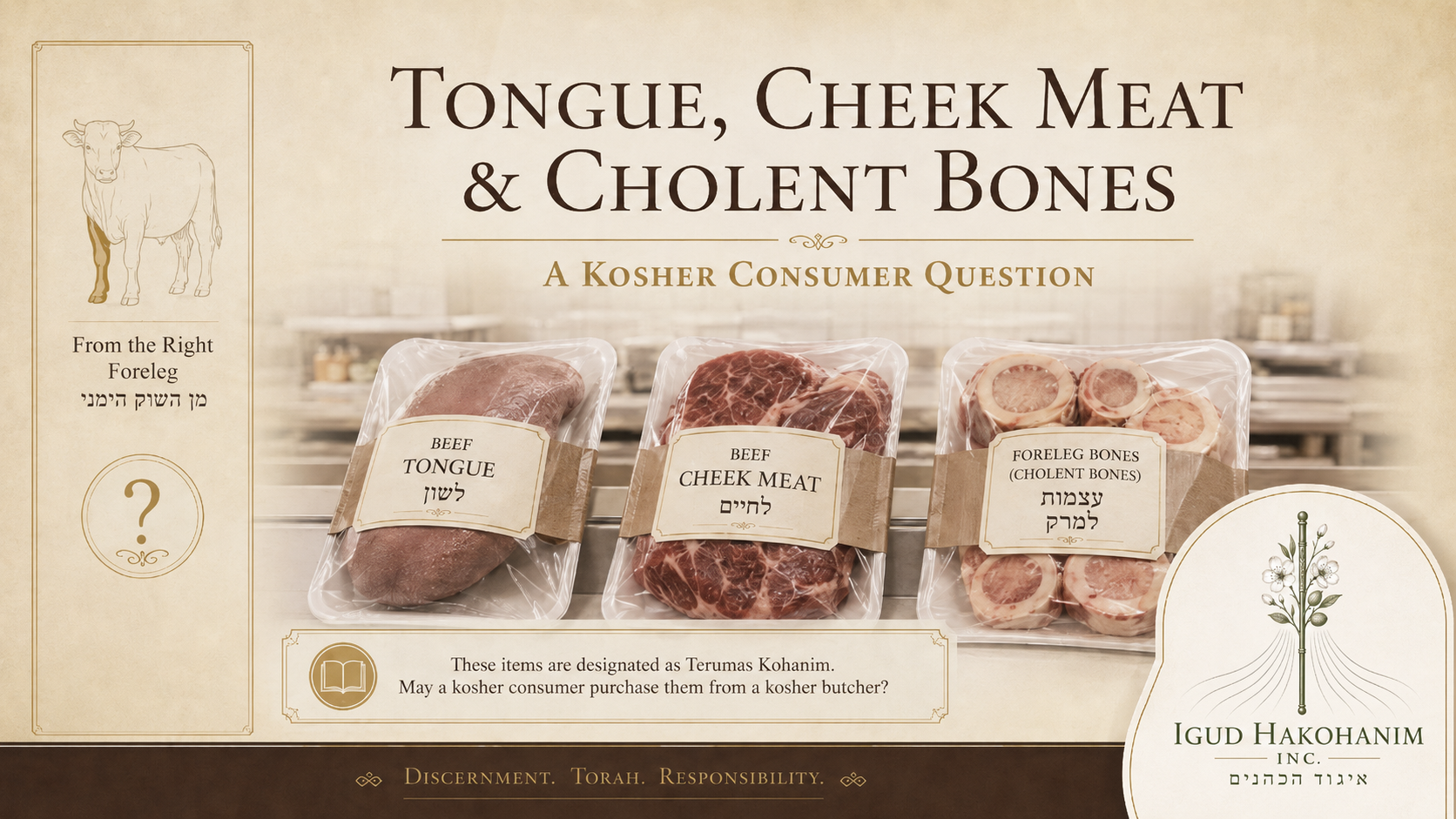
This is why tongue, cheek meat, portions from the right foreleg and the abomasum deserve particular attention when they move into ordinary processing or retail channels. The issue is no longer merely that the animal once contained priestly gifts; the consumer may be encountering the designated portions themselves.
Institutional guidance
Igud HaKohanim’s Position
These portions are the Kohen’s Torah-designated due. Responsibility for separating and delivering them belongs on the slaughter side of the process.
The shochet occupies the decisive point. His act of slaughter brings the obligation concerning these gifts into practical effect, and he is positioned to ensure that the designated portions are addressed before they enter ordinary processing and retail distribution.
Igud HaKohanim’s certification in this area is based upon actual separation and delivery of the gifts. Substitute arrangements, waivers, token payments or ownership devices are not treated by Igud HaKohanim as equivalent to delivery of the Torah-designated portions.
Modern refrigeration, freezing and transportation allow the gifts to be preserved and delivered in an orderly manner.
For the kosher consumer
The Practical Takeaway
Ordinary Cuts
The remainder of the animal is permitted. This page is not a claim that every piece of beef becomes prohibited because the gifts were not given.
The Gifts Themselves
The actual foreleg, cheeks and abomasum remain the Kohen’s due and should not simply be absorbed into ordinary commercial meat.
Solve It Upstream
A properly organized system handles the gifts at slaughter, before they enter ordinary retail distribution.
Sources and further study
Detailed References
The public discussion above is intentionally concise. The principal textual and supporting references are collected here for readers who wish to examine the matter more closely.
Open the source references
- Chullin 132b. Rabbi Yochanan’s statement concerning eating from an animal before its gifts were separated and the comparison to tevel. View source
- Megillah 28a. Parallel transmission concerning an animal whose priestly gifts were not separated. View source
- Sheiltot of Rav Achai, Sheilta 169. Early Geonic transmission of Rabbi Yochanan’s statement.
- R. S. K. Mirsky, critical edition of Sheiltot, Sheilta 169. Mirsky’s variant apparatus records לית הילכתא כוותיה as absent from the manuscript body texts and present on the margins of the Vatican and Sassoon witnesses.
- Yerachmiel Brody, לתולדות נוסח השאילתות. Study of the Sheiltot textual families and the relationship of manuscript marginal corrections to the textual family of the first printed edition.
- Roi HaKohen Zak. His research brings together the Sheiltot passage, Mirsky’s manuscript evidence and Brody’s textual analysis concerning לית הילכתא כוותיה. Read the study
- Hebrew Union College Sheiltot manuscript. The manuscript displayed above preserves the passage without לית הילכתא כוותיה. View manuscript image
- Tosafot on Chullin. Among the important discussions behind the stronger expression טבלים ממש and the relationship between these gifts and terumah.
- Rosh, Chullin, chapter 10. Places responsibility for the gifts on the slaughterer while distinguishing שאר הבשר, the remainder of the meat, as permitted.
- Semag, Positive Commandment 142. Distinguishes the permitted remainder of the meat from the actual priestly gifts.
- Shulchan Aruch, Yoreh Deah 61. Practical rulings concerning the gifts, their separation and their delivery. View source
- Tosefta, Chullin 10:1; Minchat Bikkurim. Relevant to the purchaser’s position when the actual designated gifts themselves are present.
- Pri Toar; Machazik Beracha; Tiferet Yaakov; HaEmek She’elah; Kreiti uPleiti. Further discussions concerning separation, Rabbi Yochanan’s tevel comparison, the status of the remainder of the meat and personal stringency.
- Igud HaKohanim. For the broader presentation of the commandment, identification of the portions and responsibility at slaughter: Zeroa, Lechayayim and Keva: Tradition and Practice .
Support Kehuna Research & Education
Help Preserve and Advance the Work of the Kehuna
Igud HaKohanim researches manuscripts, classical sources and practical implementation so that the Torah instructions concerning the Kehuna can be presented clearly and responsibly to the present generation.
Your support helps sustain research, education, certification and public-awareness work concerning the gifts and responsibilities of the Kehuna.